Using Random Images for Memory and Brain Training
Most memory training advice focuses on words: mnemonics, acronyms, repetition drills. But your brain is much better at remembering pictures than it is at remembering words, and that gap is bigger than most people realize. Random images give you an endless, unpredictable supply of visual material, which turns out to be exactly what several well-studied memory techniques need to actually work.
This isn't a vague wellness claim. It's based on a real, replicated finding in cognitive psychology called the picture superiority effect, and it's the reason flashcard apps added images, the reason memory champions build elaborate mental palaces out of vivid visual scenes, and the reason a pull of unrelated images from a random picture generator can double as a legitimate brain training tool. Here's how to actually use one for that.
Why Pictures Stick When Words Don't
The picture superiority effect is one of the more robust findings in memory research: people recall images at noticeably higher rates than they recall the equivalent information presented as text, and the gap widens the longer the delay between study and recall. A list of ten words might get you 50-60% recall after a few days. Ten distinct images of the same concepts, shown the same number of times, routinely score higher.
The leading explanation is dual coding theory - the idea that pictures get processed and stored through two separate memory pathways (a visual code and a verbal code you generate when you mentally describe what you're seeing), while plain text mostly only gets the verbal pathway. Two independent retrieval routes mean more chances to jog the memory later, even if one pathway degrades.
This matters for anyone trying to train memory deliberately, whether that's a student cramming for exams, someone doing cognitive exercises for general brain health, or a person specifically practicing recall as a mental fitness habit. Plain repetition drills lean entirely on the weaker verbal pathway. Random images are a fast, free way to add the visual pathway back in, and because a random image generator pulls from dozens of categories, you get real variety instead of the same handful of stock photos your brain gets used to and stops actually encoding.
The Method of Loci, Rebuilt with Real Images
The method of loci - commonly called a memory palace - is the technique most competitive memory athletes use to memorize long sequences: playing card decks, digit strings, ordered lists. The core idea is to mentally place vivid images along a familiar route (your house, your commute) and then walk that route in your mind to retrieve them in order.
The technique lives or dies on how vivid and specific your mental images are. Vague images barely encode. Specific, surprising, sensory images encode strongly. This is exactly where most people struggle when they try to build a memory palace from scratch - inventing ten distinct, memorable images on demand is hard, and your imagination tends to default to generic, forgettable pictures.
Random images solve this by handing you the vividness instead of asking you to invent it. Pull ten random images - a dragon, a city skyline, an ocean wave, a cat - and place each one at a specific point along your familiar route. Because the images are unrelated and specific, they're inherently more memorable than the generic mental pictures most people default to inventing themselves. To memorize an actual list (groceries, a speech outline, a study sequence), link each item you need to remember to one of these random images through a quick, absurd mental connection: item three is "riding" the dragon, item seven is "sitting on top of" the city skyline. The randomness does the heavy lifting; you just supply the connective absurdity, which is the part your brain remembers best anyway.
Spaced Repetition with Images Instead of Words
Spaced repetition - reviewing information at increasing intervals right before you'd naturally forget it - is the most evidence-backed method for long-term retention, and it's the engine behind apps like Anki and SuperMemo. Most people use it for vocabulary or facts. Fewer people realize it works even better when the "cards" are images rather than text.
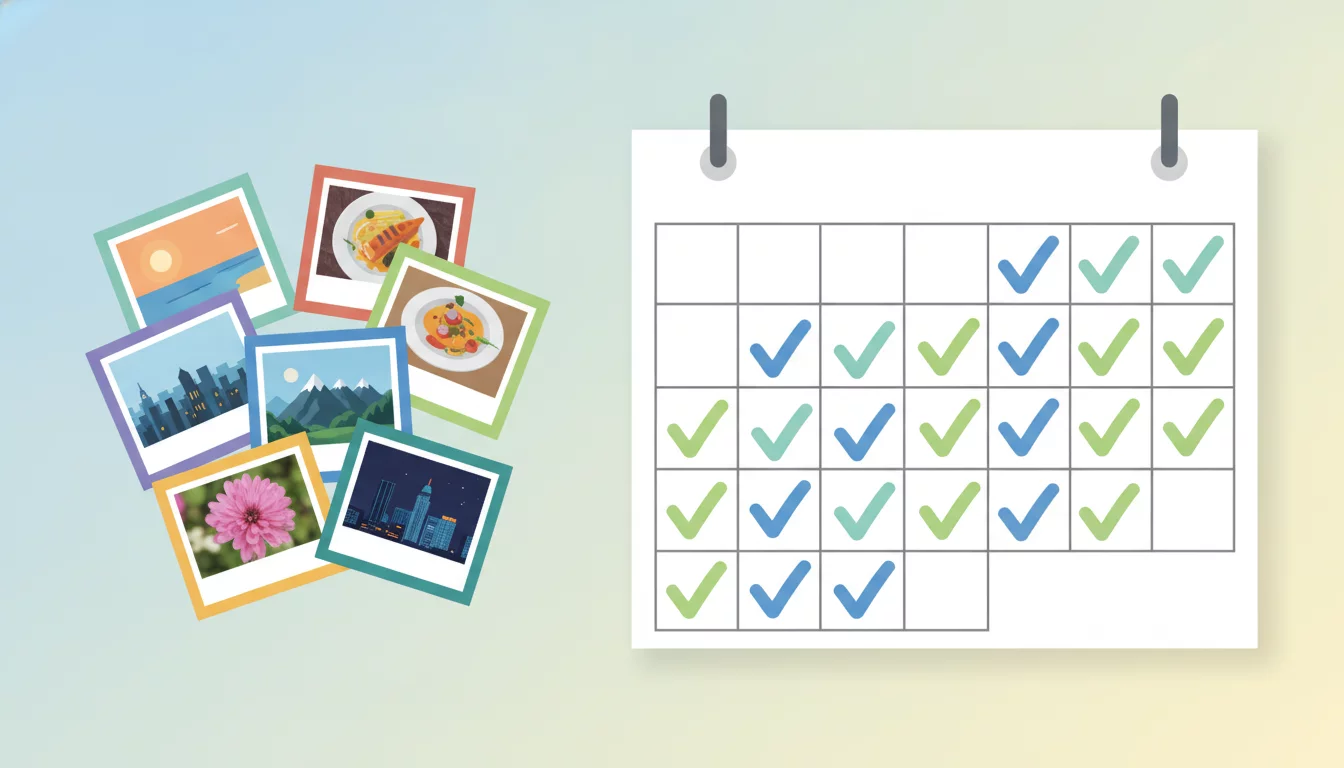
A simple visual spaced-repetition drill: pull five random images at the start of the week. Study each one for 15 seconds, then look away and describe it in as much detail as you can - color, composition, small background details, not just the obvious subject. Review the same five images the next day, then again three days later, then again a week later, each time trying to recall details before looking. By the third or fourth review, you'll notice you're recalling specific details (a particular cloud shape, a background object) that you'd swear you never consciously registered the first time. That's the visual pathway doing real encoding work, not just recognition.
This exercise works especially well across categories rather than within one. Reviewing five random flower images trains you to notice differences between similar things, which is a genuinely useful and underrated memory skill (it's the same skill involved in remembering which of your coworkers said what, or which similar-looking document is which). Reviewing five images spanning totally different categories - a mountain, a plate of food, a car, a butterfly, a person - trains something different: rapid context-switching recall, which is closer to what real-world memory demands actually look like.
Working Memory Drills: The "Glance and Rebuild" Exercise
Working memory - your ability to hold and manipulate a small amount of information for a short period - is different from long-term memory, and it responds well to a specific kind of image-based drill. Unlike long-term recall exercises, working memory drills are about a single, brief exposure and immediate reconstruction, not repetition over days.
The exercise: pull a random image and look at it for exactly 10 seconds. Then close your eyes (or look away) and try to mentally reconstruct it in as much detail as possible - not just "there was a building," but where the building sat in the frame, what was to its left, what color dominated the sky, whether there were people visible. After 20-30 seconds of reconstruction, look at the image again and check your accuracy. What did you get right? What did you completely miss?
Do this with five to ten images in a session, and you'll notice a pattern in what you consistently miss - most people are strong on the central subject and weak on peripheral details and spatial relationships. That's useful information about your own attentional habits, and deliberately trying to notice peripheral details in the next round is where the actual training happens. This drill takes about five minutes and works well as a short daily habit rather than an occasional long session; consistency matters more than duration here, the same way it does with physical exercise.
Category Recall: Training Categorical Memory
A different kind of memory skill - categorical memory, or your ability to remember which bucket something belongs to - responds well to a specific random-image exercise. Pull 15-20 random images spanning several categories (mix in architecture, birds, space, sunsets, and a few others). Look through all of them once, at a natural pace, without trying to memorize anything specific. Then, without looking back, try to list every category you saw and roughly how many images fell into each one.
This mirrors a real cognitive skill: remembering the shape of a body of information you encountered, rather than every individual detail within it. It's the same skill involved in recalling "there were three main arguments in that article, one about X" without necessarily recalling each argument's specifics. Most people find this harder than they expect on the first attempt and improve noticeably within a few sessions, which makes it a satisfying drill to track progress on over a couple of weeks.
Why Randomness Matters More Than It Seems
You could do all of these exercises with a personally curated set of images instead of random ones, so why does the randomness specifically help? Two reasons, both grounded in how memory actually works rather than just being a nice-to-have.
First, familiarity is the enemy of encoding. If you build your own image set, you unconsciously gravitate toward images you already find memorable or meaningful, which defeats the purpose of training recall on genuinely new material. A memory system that only gets tested on easy, personally-resonant material doesn't actually get stronger - it just gets confirmation that it already works for familiar things. Random images force encoding of genuinely unfamiliar visual information every time, which is the only condition under which memory training produces real transfer to everyday situations (remembering a new coworker's face, a new route, an unfamiliar document).
Second, variety prevents the drill from becoming rote. Any memory exercise you repeat with the same material stops training memory and starts training pattern recognition of that specific material - you're not recalling the image anymore, you're recognizing that you've seen this drill before. Because a random picture generator can produce an effectively unlimited stream of new combinations across dogs, weddings, national parks, and dozens of other categories, the drill stays genuinely novel indefinitely, which keeps the training effect real instead of degrading into memorized familiarity with your own practice set.
Building a Simple Weekly Practice
You don't need a rigid schedule to get real benefit from this. A realistic weekly structure that fits into a few minutes a day:
- Daily (2-3 minutes): Glance and rebuild. One random image, 10 seconds of viewing, then reconstruct it from memory before checking. This is the fastest exercise and the easiest to actually stick with.
- Twice a week (5 minutes): Spaced repetition review. Pull a small set of images once, then review the same set at increasing intervals over the following days, trying to recall details before looking.
- Weekly (10 minutes): Memory palace practice. Pull ten random images, place them along a familiar mental route, and use them to memorize an actual list you need for something real - groceries, tasks, talking points. Real stakes make the practice stick better than abstract drills.
- Occasional (once every week or two): Category recall. A larger batch of images across many categories, testing your recall of the overall shape of what you saw rather than individual details.
As with any cognitive training, consistency beats intensity. A few minutes daily produces more durable improvement than one long session on a weekend, because spaced practice is itself one of the core principles memory research keeps confirming works better than cramming.
Getting Started
You don't need special apps or a course to start any of this. Open the random picture generator, pull an image, and try the glance-and-rebuild drill right now: look for 10 seconds, look away, and see how much you can reconstruct. That's the whole barrier to entry - no setup, no curated deck, no subscription. Just an unpredictable image and a genuine attempt at recall.
If you're interested in other ways random images can be put to practical use, see our guide on using random pictures as drawing references, which draws on some of the same observational-attention skills this article covers, or our roundup of creative ways to use random pictures for more everyday applications beyond memory training.